
Overview
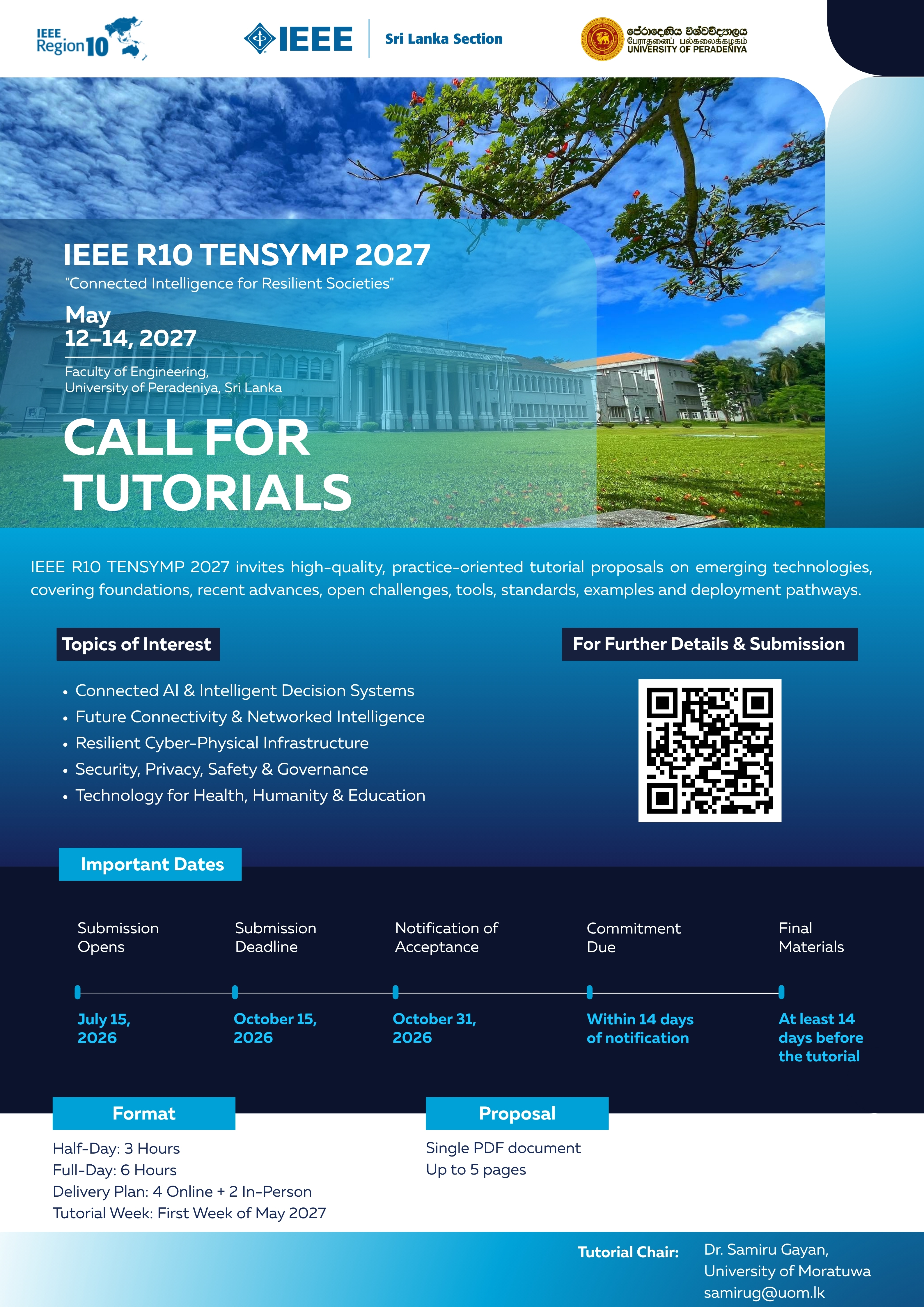
IEEE R10 TENSYMP 2027 invites high-quality, practice-oriented tutorial proposals on emerging technologies aligned with the symposium theme, "Connected Intelligence for Resilient Societies." Tutorials should combine strong technical foundations with recent advances, practical applications, demonstrations, tools, standards, open research challenges, and deployment pathways. Proposals are welcomed from researchers, industry practitioners, standardization experts, technology innovators, and multidisciplinary teams.
The tutorial program is intended for researchers, engineers, postgraduate students, industry professionals, policymakers, and other participants interested in intelligent connected technologies that strengthen societal resilience.
Six tutorials are planned during the first week of May 2027: four online tutorials and two in-person tutorials. Proposals may be submitted as:
- Half-day tutorial: 3 hours
- Full-day tutorial: 6 hours
Half-day tutorials should provide a focused technical exploration with clearly defined outcomes, practical examples, or demonstrations. Full-day tutorials may include foundations, advanced methods, case studies, hands-on activities, tools, and discussions of open challenges.
Topics of Interest
Tutorial proposals should align with the symposium theme and may address, but are not limited to, the following areas:
- Connected AI and Intelligent Decision Systems
- Future Connectivity and Networked Intelligence
- Resilient Cyber-Physical Infrastructure
- Security, Privacy, Safety, and Governance
- Technology for Health, Humanity, and Education
Tutorial Proposal Format
Tutorial proposals must be submitted through EDAS as a single PDF document not exceeding five pages. The EDAS submission link will be announced on the symposium webpage once the tutorial track is available.
Each proposal should include the following information:
- Proposed tutorial title
- Preferred delivery mode: online or in-person
- Preferred duration: half-day or full-day
- Abstract and motivation
- Tutorial objectives and expected learning outcomes
- Intended audience and prerequisite knowledge
- A detailed tutorial outline, including the proposed schedule and presenter allocation
- Details of demonstrations, hands-on activities, software tools, datasets, platforms, or standards to be covered
- Names, affiliations, contact details, and brief biographies of all presenters
- Evidence of presenter expertise, including relevant publications, projects, standards activities, industrial deployments, or professional experience
- Details of previous tutorial, workshop, or training experience
- Plans for participant interaction, inclusive delivery, accessibility, and post-tutorial learning resources
Selection Criteria
Tutorial proposals will be peer-reviewed. Proposals will be evaluated according to the following criteria:
- Alignment with the symposium theme
- Technical quality, relevance, timeliness, and originality
- Relevance to the IEEE community
- Clarity of the objectives and expected learning outcomes
- Suitability for the intended audience
- Balance between theoretical foundations and practical content
- Quality of demonstrations, hands-on activities, case studies, tools, or deployment examples
- Expertise and experience of the presenters
- Diversity of presenters and perspectives
- Potential to attract participants from academia, industry, government, and the wider professional community
Accepted presenters must confirm their participation within 14 days of receiving the notification. Tutorial titles, abstracts, and presenter biographies will be published on the symposium website.
Final tutorial materials must be submitted at least 14 days before the tutorial. Presenters are encouraged to provide slides, reading lists, software, datasets, exercises, and other supporting resources. All presenters must follow IEEE expectations relating to professional conduct, inclusivity, and accessibility.
Important Dates
| Milestone | Date |
|---|---|
| Call for Tutorials: Opening Submissions | 15 July 2026 |
| Deadline for submitting Tutorial proposals | 15 October 2026 |
| Notification of acceptance for Tutorial proposals | 31 October 2026 |
| Tutorial Program | First Week of May 2027 |
Submission and Enquiries
Tutorial proposals must be submitted through the Google Form below.
Submission link: https://docs.google.com/forms/d/e/1FAIpQLSduvpMv7BlRsAhfU9hfct1QJWFbC3xclJ0r64au3xex8Z7VQw/viewform
For enquiries, please contact the Tutorial Chairs and use "TENSYMP 2027 Tutorial Proposal" as the subject of your email.